
- ଓଡିଶା ସରକାର Government of Odisha |ଓଡ଼ିଆ ଭାଷା, ସାହିତ୍ୟ ଓ ସଂସ୍କୃତି ବିଭ Depart
- CALL SUPPORT :
- 0674 2503956
- E-Mail :
- principalusm@gmail.com

Department of Instrumental Music
| * Department of Vocal Music (Odissi Vocal & Hindustan Vocal). | * Department of Instrumental Music (Odishi Pakhwaj , Tabla, Flute, Hindustani Violin, & Sitar) |
| * Department of Dance (Odissi Dance & Chhow Dance). | * Department of Drama (Stage Craft, Acting & Direction). |
Tabla
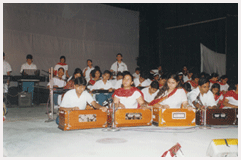
The Tabla takes its name from Tabla of Arabic origin. The general meaning of the term Tabla is an instrument facing upwards, with a flat surface. Tabla makes it possible to give a Raga to music and make a rhythm .
We at Utkal Sangeet Mahavidyalaya make it possible for students to become Masters in Tabla Badan.
Flute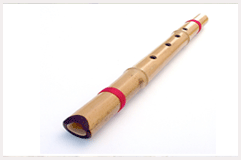
Bansuri is a very sensitive instrument. Almost all the delicate graces, curves, embellishments and shades of classical music can be performed to perfection upon it. The highest order of music can be played on this instrument, and its resonance in mandra saptak (lower octave) leaves a rare charm in the minds of its listeners. Being a portable instrument, it can be carried easily from place to place and climatic changes have very little or no effect on the seasoned bamboo.
At Utkal Sangeet Mahavidyalaya we train students to combine Music with Flute.
* Sitar
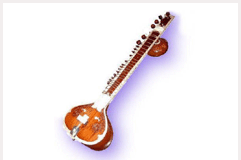
Sitar is the most popular instrument in Hindustani music. The structure and tonal quality of the modern sitar is a result of several years of hard work and devotion put in by artists and craftsmen. Craftsmen of Calcutta need special mention for their contribution to the making of a structurally perfect instrument. The basic technical and physical principles of the sitar are just like those of the veena, but the sitar is easier to handle and is more portable. For centuries, the sitar has undergone a sea of transformation, and has improved beyond recognition. The twentieth century can be called the golden era of the sitar. Stalwarts like Ravi Shankar, Vilayat Khan, Nikhil Banerjee, Uma Shankar Misra, Abdul Haleem Jaffar Khan, Rais Khan and many others have carved a special niche for the instrument in the world of music.
* Violin
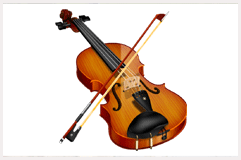
The origin of the violin is hard to trace. It underwent an extremely slows process of crystallization. Several instruments contributed to its formation. Fiddles, which were very common in Europe till the thirteenth century, and even later, bore some early features of the violin – they were always held on the shoulder and bowed palm downward, the bulging soundboard with depression near the outline, the projecting edges, the lateral pegs and even the four strings, which were combined together, in the end of the fifteenth century. The medieval time so became an important factor in its evolution.
At Utkal Sangeet Mahavidyalaya we teach Classical Hindustani Violin.
* Mardala (Pakhawaj)
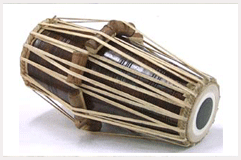
Drum is an instrument in which sound is produced by a membrane stretched and tightened over the opening of either a frame or a hollow body of any shape. Avanaddha, Anaddha, Vitata, etc., are the synonyms used for membraphonic instruments in India. Since the term drum has become a generic word used for each and every type of rhythm instrument, Avanaddha vadya of India can also be called drums. Percussion is another term which can also be used in a broader sense. From times immemorial, we also have another classification, which is used in broader sense, i.e. laya vadya the rhythm instruments and swar vadya the melody instruments.
Laya vadya are the instruments used for rhythm. They are the earliest musical instruments known to human history. Laya vadya have enjoyed a certain status in India. Drums are of various types and have been classified on the basis of their position of play, their shape and structure, the material used for their making, skins or heads, and finally the manner of playing. In India since the ancient times drums have been classified on the basis of their shapes. If we go by their shapes, we can divide Indian drums into three: – Tubular Drums, Kettle Drums and Frame Drums.
At Utkal Sangeet Mahavidyalaya we teach Mardala